
Calculating Sample Size for Quality Call Audits
A common tool for assessing the quality of sales managers’ work is quality auditing of phone calls, or “call monitoring.”
Suppose your goal is not simply to measure the quality of phone calls, but to document growth in that quality. For example, you conducted training for your managers, introduced new incentives for meeting quality standards, or implemented some other intervention.

It’s reasonable to assume that an improvement in quality in the first random call recorded after the training won’t definitively prove that quality has improved across all calls. Likely, a second successful call won’t conclusively confirm the hypothesis either.
Thus, you’ll need to listen to — if not all calls — at least a sufficient number of calls after your changes, and the number of calls you’ll need to audit can, in fact, be calculated precisely.
Calculating Sample Size
On page 35 of the paper “Introduction to Statistical Inference and Experimental Design” I found a suitable example 1.9 and a formula for calculating such samples:
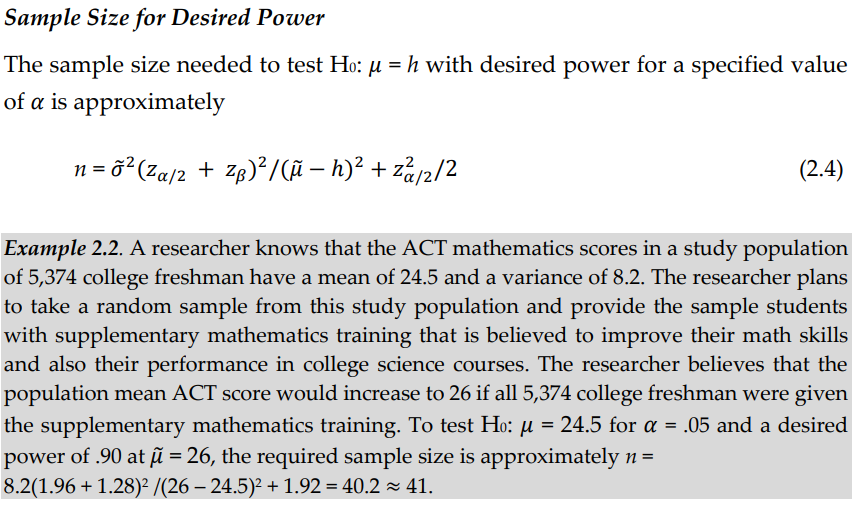
In this example, an improvement in ACT math test scores from 24.5 (variance 8.2) to 26.0 points is considered, with α = 0.05 and power = 0.90.
For convenience, I assembled the formula in a Google Sheet:
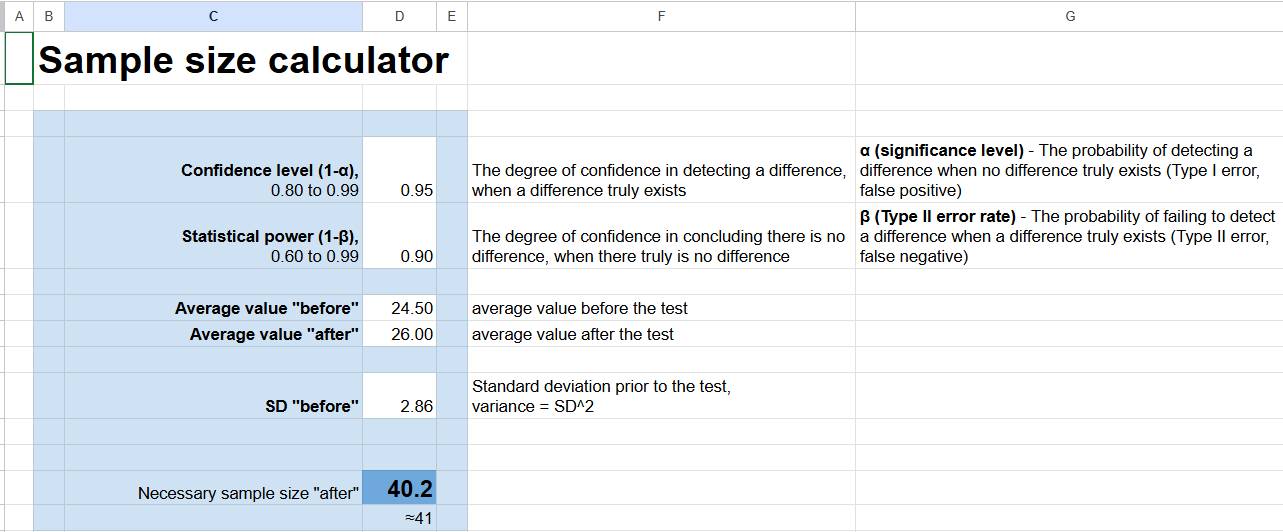
It’s reasonable to choose a confidence level between 80% and 95%, and a statistical power between 60% and 80%. Enter the average call quality score before changes, the standard deviation (SD) of call scores “before,” and the expected average call quality score “after” your changes.
See also:
https://bpb-us-e1.wpmucdn.com/sites.ucsc.edu/dist/2/1389/files/2026/03/part1.pdf